Wednesday, 28 November 2012

Philosophy lecture

Today our lecture was about philosophy and the use of philosophy in games through narrative and mechanics.

Philosophy is defined as an academic discipline that exercises logic and reason to understand reality and answer questions about reality. Philosophy can be used in design as a source of stimuli, for game mechanics and to create a deeper experience for the player. 

We looked at 2 games as examples of this, both from the game studio That Game Company.

a white silhouette of an outstretched arm and hand on a light blue background, with "thatgamecompany" above it.

That Game Company created Flow, Flower and Journey. Flower and Journey were the two games we looked at for study as they are renowned for utilizing philosophical subject matter in their games game play and narrative.

A trail of red, yellow and white petals arc over a brown-and-green grassy hill. The sun is in the upper left of the image, set in a clear blue sky, and the word "flower" is overlaid across the image, with the top of the "f" sprouting orange petals as if it were a flower itself.

Flower is a game where the player embodies a natural force that carries along petals like the wind. The game is difficult to describe, event the creator finds it difficult in the interviews we watched in class. 


Flower starts off in a room with flowers in pots on a windowsill overlooking a city, the levels are said to be dreams of the flowers that seek freedom in nature and away from the cities.


project3

Journey is the other game we looked at and is one of the two i have actually played. Journey is an enchanting experience that pairs random players together in an adventure allowing them to co-operate freely without any requirements to do so, without the pressure to perform forced cooperative tasks the players do not feel compelled to fight against the rules. 

We watched a video interview of creator Jenova Chen about  Journey as well, though the interviewer is somewhat of a moron. 


This lecture relates to an Extra Credits episode where they talk about mechanics as metaphors, in other words it is them using mechanics to showcase underlying themes. This is what i will need to do for the next project when creating a game concept from my report subject.

Saturday, 10 November 2012

Human Embryonic Stem Cell Harvesting

I've been researching embryonic stem cells for a few weeks now and through the research I've gathered i already know that the most common way scientists obtain stem cell lines is from donated embryos from In-vitro Fertilization clinics. When embryos are going to be discarded from the clinics they check with the owners of the embryos if they are willing to donate them to stem cell research. The cells would be destroyed if not so really it would be unethical to not use them for stem cell research.


This is the website of Bioethics, on the site they explain a bunch of ways that scientist car retrieve stem cells as well as the ethics of each method. The problem i have with looking at ethics is that they are largely subjective and related to religious beliefs of which i have none. On this site they respond to the question 
"Why should we value the human embryo?" with :

Underlying the passages of Scripture that refer to the unborn (Job 31:15; Ps. 139:13-16; Lk. 1:35-45) is the assumption that they are human beings who are created, known, and uniquely valued by God. Genesis 9:6 warns us against killing our fellow human beings, who are created in the very image of God (Gen. 1:26-27). Furthermore, human embryonic life—as well as all of creation—exists primarily for God’s own pleasure and purpose, not ours (Col. 1:16).

My and many other peoples view on this is that embryos are not conscious or alive, they are simply early stage cells and are is different to harvesting seeds from plants. It is true that a lot of the embryos that are used to harvest stem cells are destroyed in the process but this article from Scientific American http://www.scientificamerican.com/article.cfm?id=embryos-survive-stem-cell-harvest in 2008 talks about how scientists are now able to harvest stem cell lines from a fertilized embryo without destroying it. 

"A team led by researchers from Advanced Cell Technology (ACT) in Worcester, Mass., reports in Cell Stem Cell that it created five new stem cell lines by plucking single cells from embryos in the early blastocyst stage, a grapelike cluster of eight cells called blastomeres. Researchers normally create this kind of stem cell line at a more developed stage from the entire mass of embryonic cells." (Minkle, JR. 2008).

There are other ways to retrieve stem cells, although they are not embryonic stem cells. Adult stem cells, though not as valued as Embryonic stem cells can be obtained without any harm done to anything. Umbilical cords and placenta are both valuable source of stem cells with no moral quandaries attached. 


Wednesday, 7 November 2012

Sustainable design lecture

Today's lecture was about sustainable design, we looked at several areas that contribute to this practice. Economic, environmental and social aspects all factor into good sustainability, these elements add up to a term called "the triple bottom line". If a designed product features aspects that fulfill these requirements then it has a great chance of being sustainable. 
A video that we watched talked about these elements and the fact that they require a fourth element to be successful, function. If a product doesn't fulfill its function well then it won’t be adopted by people and the elements of the triple bottom line will not be carried across to the world.

Sustainability has many benefits in various areas, an area we looked at was sustainable energy and how it is affecting cars. Oil will eventually run out and it is forcing people to find new ways of making cars and look for new fuel sources. They hybrid car was looked at, I know a fair amount about hybrid cars and firmly believe that even though they tick the boxes to make it a sustainable product, it is in fact a false positive. Hybrid cars use two engines, the traditional combustion engine fueled my fossil fuels and an electrical engine powered by a battery. These engines work in conjunction with each other to lower the amount of petrol the car uses, the fact is that hybrid cars still use petrol and the majority or electricity the cars use come from power plants that still use finite or harmful resources. The cars do reduce the cost of travel by reducing the amount of petrol they require which fulfills the economic side of the triple bottom line. The hybrid cars do reduce the amount of pollution output from the cars. The hybrid cars do help put across the message of caring about your carbon footprint. These all fulfill the triple bottom line, the problem is that the function of the product does not support this, the hybrid car is simply a half step in the right direction and not the full innovation the world needs.

We later looked at how this method of sustainable design can be and is used in games design. One of the mode obvious cases was the digital media and content, digital games have no packaging and thus no damage on the environment, they often have large communities that form their own cultures and in some cases their own markets and economies, the ability to increase the longevity of a game through online purchases gives credit to the economic side of the argument. Some prime examples of games that have had good sustainable design shown bellow.

Little Big Planet Logo
Whats cool for kinds. (n.d.). Retrieved from http://www.whatscoolforkids.com/littlebigplanet.html
Little bog planet has sustainability through user generated content, long after the game had shipped the players were creating increasingly more imaginative levels. This game had user generated content as a focus from the start of development and it carried the game past release.


League of Legends Logo
Foroughi, C. (n.d.). League of Legends: The Unsung Hero of the Online Competitive Gaming Scene. Retrieved from http://obsoletegamer.com/league-of-legends-review/

League of legends is an online multiplayer game that has a large community, the game itself is free and makes it's money through micro transactions.

Tuesday, 6 November 2012

Human Embryonic Stem Cell Research


I didn't actually realise until i came to do some more writing of my report that i haven't really uploaded my research here. I had been gathering it all in my research document and when i came to blog about my weekly lessons it just didn't occur to me to upload my research. I'm supposed to be doing this work on Wednesday during lesson if i have the chance and then roughly 2-3 hours of work at home, then work on Saturday. My Saturdays have been a bit hectic and unstructured of late so i will try to make it my day i upload my weeks work, I've recently been very forgetful of the work I've done, i can't remember much of my research and i can't remember the work I've done in other modules. I'm hoping getting an upload routine may help me.


Anyway, whilst i'm here i will upload some of my research.


This website had informed me of a great deal of information about Embryonic stem cells themselves and the history surrounding their discovery, it was very helpful in getting me up to speed on some of the facts. I knew a fair amount about them before but most likely no more than the average person that had read about them.

sadad
Rowland, T (2009), Human Embryonic Stem Cells: A Decade of Discovery, Controversy, and Potential, Retrieved from http://www.allthingsstemcell.com/2009/04/human_embryonic_stem_cells/

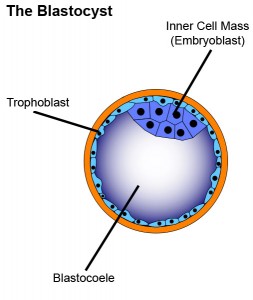
This image by itself probably means nothing to the layman but reading through the website article explained that this is infact an embryo in a stage of formation called the Blastocist stage which occurs early in the development cycle.

"the blastocoel, which is a fluid-filled cavity within the blastocyst, and the inner cell mass, also known as the embryoblast, which can become the embryo proper, or fetus, and is where hESCs are isolated from."


Saturday, 3 November 2012

Medical Pamphlets

For my report i decided to go with something themed appropriately, i chose a medical pamphlet. I figured i would need to get some example and since my scanner is currently busted I've just have to get some examples of the web. After looking at these and making my own layout in Microsoft Publisher i am slightly concerned that 3000 words may not fit onto a two sided pamphlet. I will have to look at alternatives just in case.
indesign-template-medical-center-brochure1indesign-template-medical-center-brochure2
Graphire, (2009). Free InDesign Templates: Brochure and Menu. Retrieved from http://www.designfreebies.org/design-templates/indesign-templates/free-indesign-templates-brochure-and-menu/

Uses of Embryonic stem cells

Embryonic stem cells are not actually used in practice yet, they are still an experimental biological tool harvested from donated embryos. Because of this they currently have no uses and all uses talked about are simply potential uses until proven that they work. One use that is proven is the stem cells original use, scientists know that the original use of a stem cell is to create other cells, many scientist speculate at being able to use stem cells to regenerate vital parts of the human anatomy, one i found frequently was spinal cord regrowth to help people regain the ability to walk. 

Since their are so many avenues of medical science there are many speculative possibilities as to what could be done with these little cells. Now that the science is being helped rather than hindered due to new funding and less governmental opposition many of these avenues have dipped into what they could use these cells for.


This site talked about the possibly of using stem cells for early drug trials instead which would be much safer and potentially cheaper than animal trials. Human trials are still many many years away but the possibilities are vast.

Regenerative medicine is definitely the main focus or at least the area of research that has garnered the most attention, although there has been some interesting work on reversing the effects of cancer cells by using a stem cell framework.